

Stroke remains one of Australia’s biggest health challenges. Around 46,000 stroke events impacted
Australians of all ages in 2023 – that’s one every 11 minutes. Research shows that 80 percent of strokes
can be prevented by getting regular health check-ups, managing blood pressure, cholesterol, being active,
avoiding smoking and excess alcohol consumption.
For those who experience a stroke the recovery can be a long and arduous process. But understanding more about the needs of people, and at what point in their recovery journey they need information and assistance will improve the experience.

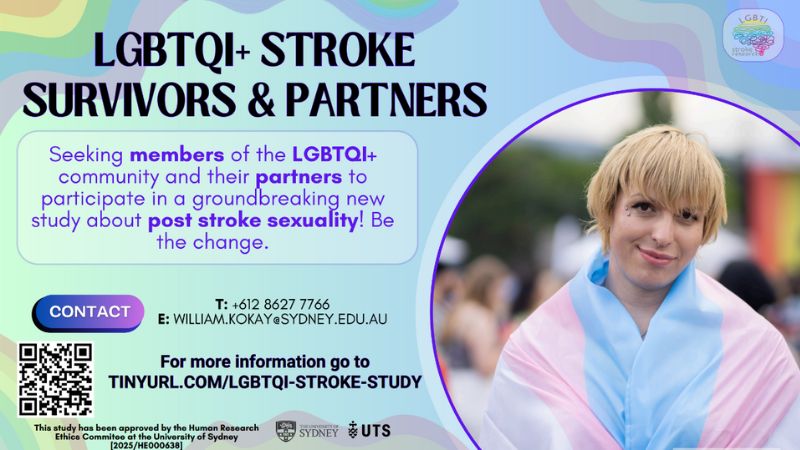
While there’s constant research into the topic, one researcher is focusing on how LGBTIQ+ people are affected by strokes, and how it affects their sex lives.

William Kokay’s interest in this area began six years ago when he was was working as a health care social worker in stroke rehabilitation.
“I was working in stroke rehabilitation, and a lot of my patients were LGBTIQ+ and I found the patient found the resources were largely heteronormative.” Kokay shared with OUTinPerth.
After delving deeper into the lack of materials he discovered that there was not a lot of specific research about how stoke affects people in the LGBTIQ communities. Kokay is now a PhD candidate at the University of Sydney and continuing his research.
Kokay explains that stroke, which are the result of a blood clot in the brain or a brain bleed, can affect people in many different ways, and the rehabilitation journey can be very varied.
“With stroke it depends, firstly if you have a blood clot versus a bleed. It also depends how soon doctors and hospitals get to you or you get to them, because there’s what they call the ‘golden hour’, and there’s a four hour time frame that we can actually intervene in. Outside of that it could end up more disastrous.
“It also depends on where it’s happened in the brain. So there’s parts of the brain is the function for speech and behavior and other parts for physical functioning.”
Kokay says most of the research focuses on important areas like speech and mobility, but argues that a more holistic approach to recovery is better, and that included people’s sexuality.
“It’s quickly becoming more recognisable that we need to actually focus beyond the walking, the talking, the driving again – and actually look at the whole of the person and that’s where sexuality comes in.”
“Its not just about sexual intercourse, but it’s about dating, relationships, body image, self esteem and gender expression. It’s all of that combined.”
Kokay also notes that recovering from a stroke is not limited to older members of society, a wide range of risk factors can increase the potential of a stroke including drug use, obesity, undetected health conditions, stress and risk can increase with for people taking some medications or hormone treatments.
Previous work Kokay completed looked at the impact of strokes on people’s sexuality and how how members of the LGBTIQ communities experienced rehabilitation. Now for the next stage he’s looking for people to share their experiences for more research.
“We’re looking at what people need and prefer when it comes to sexuality and post stroke rehabilitation.” he shared.
“We’re asking, what areas of sexuality are important? We want to know what help is needed, then we look at health professionals. It’s one of the hardest areas because health professionals do not talk about it.”
“We will be asking participants, how do you want health professionals to approach this topic. Did you want them to talk about it? When did you want them to talk about it? Is the best time when you first have the stroke, is it when you’re in rehab, or is it with your GP, is it after rehab and when you’re home?” he said.
The next stage will be to create resources for medical staff so they can better meet the needs of members of the LGBTIQ+ communities.
The study is open to people who are aged 18 years and older, living in Australia, New Zealand, USA, Canada or United Kingdom, who identify as lesbian, gay, bisexual, transgender, queer / questioning or intersex, and have experienced a stroke or are a partner of a person who has experienced a stroke.
Participation involves an interview with Kokay. The study has been approved by the Human Research Ethics Committee at the University of Sydney.
Find out more about this project.